|
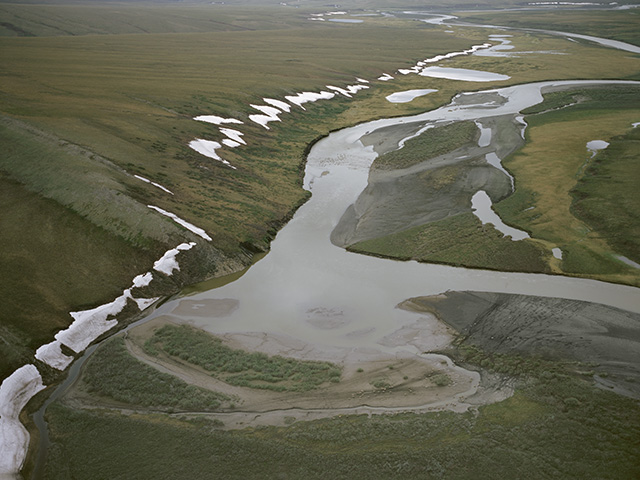
CARIBOU CROSSING THE UTUKOK RIVER | Coal and The Caribou | 2006 | 59x74 inches
The Utukok River Upland is the core calving area of the Western Arctic caribou herd, the largest herd in Alaska with nearly 490,000 animals. The herd ranges over a 140,000 square-miles area and about forty communities, including Inupiat, Yupik and Athabascan, are located within the range of the herd. For these indigenous people, the herd is both a vital link to their cultural heritage and a staple of their diet. Underneath the herd's calving ground lies the largest coal deposit of North America, an estimated four trillion ton of bituminous coal, about ten percent of world's known coal reserves. While coal is heavy and difficult to transport, there has been past proposal and current proposal to develop this area for coal. On July 14, 1958, Edward Teller, the father of the hydrogen bomb, arrived in Alaska to unveil Project Chariot, a plan to carve a new harbor out of the Alaskan coast by detonating six nuclear bombs. Due to the effort of a handful of Inupiat people from Point Hope, and few biologists and conservationists, finally the United States Government was prevented from inflicting a catastrophe worse than Chernobyl. Among other things to lure Alaskan businesses, Teller's team proposed that such a harbor would enable transport of coal from the Western Arctic. On July 30, 2006, Arctic Slope Regional Corporation signed an agreement with BHP Billiton, a Canadian mining company to explore and develop coal outside of the Petroleum Reserve, and exploration started the same year, despite opposition from traditional Inupiat communities. Petroleum and coal are the two key contributors to climate change. In addition, coal burning power plants and oil refineries from around the world are among the key contributors to toxins, that are ending up in the arctic ecology at an alarming scale. These toxic compounds bio-accumulate and bio-magnify in the animals - from polar bears, fish, seals, and whales, to women's breast milk. The Arctic, traditionally thought of as the last great unspoiled territory on Earth, has become home to some of the most contaminated people and animals on the planet, and breast milk of high arctic women in Greenland and northern Canada have become contaminated to the point of being considered hazardous waste.
|